Published April 11, 2026 by Ivan Howard B. Sumauang
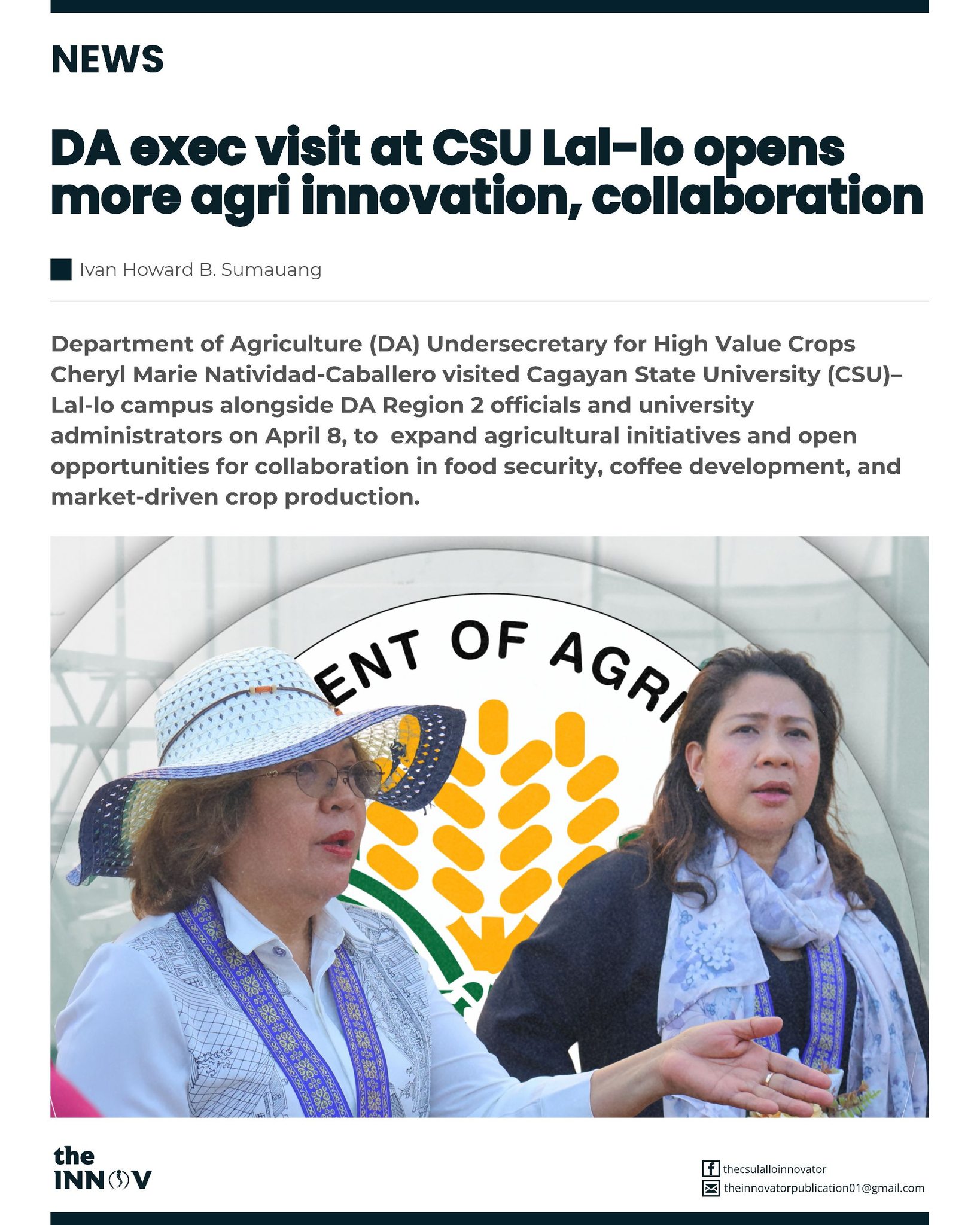
Department of Agriculture (DA) Undersecretary for High Value Crops Cheryl Marie Natividad-Caballero visited Cagayan State University (CSU)–Lal-lo campus alongside DA Region 2 officials and university administrators on April 8, to expand agricultural initiatives and open opportunities for collaboration in food security, coffee development, and market-driven crop production on.
The visit, facilitated by former CSU president now a member of the CSU Board of Regents, Dr. Urdujah G. Alvarado, CESO II, went beyond a ceremonial tour as CSU Lal-lo showcased key agricultural facilities and flagship projects that officials said could serve as models for wider regional development.
Among the areas visited were the campus coffee hub, a view deck overlooking the coffee plantation, the nursery, and the greenhouse complex.
The officials were also briefed on the university’s long-term plans to align crop production with industry demand and institutional sustainability.
Usec. Caballero shared her vision of a “farm-to-table” system, where the campus would supply and process its own ingredients for use in the hospitality management program. She emphasized the need for market-oriented farming.
“We need to identify crops that are truly recommended and suited to market demand. Why plant if there is no demand? It would only go to waste,” she said.
Her remarks reinforced CSU Lal-lo’s move to establish additional high-value and cash crops such as ube and sweet potato, which officials said could provide short-term income while waiting for coffee plantations to mature. These crops are being considered as supplemental revenue sources to help finance the maintenance requirements of the campus’s coffee project.
CSU Lal-lo also presented its broader agroforestry and campus farming projects, which the DA wants to integrate into a single, connected value chain. The long-term vision is to create a more sustainable agricultural ecosystem combining coffee, agroforestry, and complementary crops to augment farmer income and strengthen research-based production models.
One of the major highlights of the visit was the discussion on the Department of Agriculture–National Urban and Peri-Urban Agriculture Program (DA-NUPAP), which has already extended substantial support to CSU Lal-lo.
“The purpose of DA-NUPAP is to help ensure food security so that we have enough food supply,” Diosa Alasaas, campus research coordinator, said.
She said CSU Lal-lo received support for a greenhouse, native poultry, and mushroom production components amounting to P2.55 million.
Additional in-kind assistance for edible landscaping and vegetable seed production, valued at P650,000, brought the total package of assistance to P3.2 million, including the greenhouse facility.
Roje Marie Rosqueta, campus extension coordinator, said the university had initially planned to showcase a newly established coffee area and a wider range of crops during the visit.
She said the proposed beekeeping project is intended to strengthen natural pollination within the coffee plantation while creating an additional livelihood and value-adding stream through honey production.
She explained that bees and coffee flowers maintain a symbiotic relationship, making them natural pollinators that can improve fertilization and productivity.
Campus officials are also conducting tree-marking activities to remove non-essential species, including African tulips, which were identified as one of the factors limiting bee population growth in the area.
The university also renewed discussions on a proposed solar-powered irrigation upgrade, building on an existing 5-kilowatt solar installation near the greenhouse.
Said proposal will be submitted to enhance the current system and make it sufficient for future irrigation demands, particularly as expansion plans move forward.
Also among the proposed projects submitted to the DA are tissue culture initiatives and multilocational coffee trials, which include detailed profiling of coffee varieties for quality assessment, export potential, and value-adding opportunities.
Rosqueta said the profiling initiative is crucial because each coffee produce carries unique characteristics that may increase its competitiveness in premium and export markets. #